Friday, March 23, 2018

Week note for March 19-23

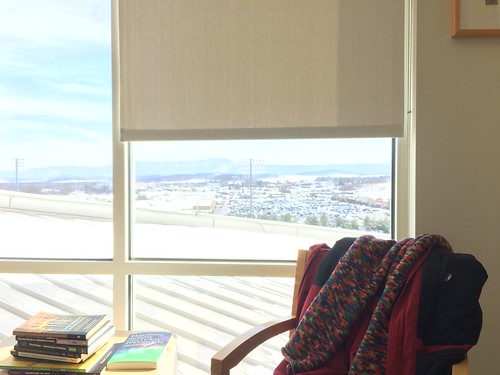
Winter Office flickr photo by AABQ shared under a Creative Commons (BY-SA) license

I stole the week note idea from Doug Belshaw. Thanks, Doug!

Back to the old trot

The jet leg is wearing off! Upon returning from Germany, it was nice that I could go to bed between 9 and 10, and immediately fall asleep, waking up again around 5. This meant that I could get an hour of writing in before breakfast. Unfortunately, this is getting more difficult now, though I try to keep it up. Have to go abroad for another week, I guess!

Snow days!

On Tuesday afternoon and Wednesday, JMU was closed due to snow and ice. This was a welcome opportunity to catch up with some work, particularly on Wednesday, since I didn’t have time for my commute. Of course, this was off-set by some time playing in, er, shoveling, snow.

Sadly, we also had to cancel a committee meeting early on Thursday, since several members were not able to make child care arrangements in time: public schools were closed as well.

Writing

I finally finished my piece on professional identities of educational developers. Even though it seemed to be almost done by late Tuesday, it took me another full snow-day of work on Wednesday to finish it. It’s not a great piece — mainly literature review with theory and discussion — it was an invited contribution, and I was so late that it might get rejected by the editors. If this happens, I won’t be mad, since it’s just fair, and the piece really isn’t great (but I am not one to aspire to greatness).

I always find literature reviews to be hard going: How do you combine summaries of different sources into a coherent argument? That’s tough! I hope I’ve been fair to the sources, have not omitted anything important (but I ran out of the allotted space anyway), and did not misrepresent any author.

Whether the piece gets published or not, I now have much more clarity in my readings. I cannot wait to carefully re-read the sources that I used, and to discover new sources that I coulda/shoulda used.

Reading

On my Germany trip three weeks ago, I finish Eleanor Catton’s The Luminaries. Plane trips are great to get through thick books. I liked it: beautiful, well-written, entertaining, with interesting narrative tricks. It didn’t bowl me over as, say, Larry Durrell’s first two Alexandria Quartet volumes (but I’m not the same person).

In Germany I started Herman Hesse’s Der Steppenwolf, picking it up from my mother’s book shelf. I am prejudiced against Hesse, partly because of his corny and involuntarily comic poetry. Der Steppenwolf is more readable, but in many respects it confirms my suspicion that Hesse is overrated. More on this at another time, maybe.

I’ve also started Sophia, der Tod und Ich, which I bought on a whim at a bookshop. Worth it! Good example of German humor at its best. I am also giving Captain Blaubaer another try. I needed this combination, I felt: Something serious, interesting, but pretentious; something seriously humorous; and something that’s a bit of a silly romp.

Enough fun, now for some work reading:

Tragically and unexpectedly, Lee Ann Fujii died about two weeks ago. Here is her article on the lack of diversity in political science that all political scientists should read.

The Journal on Excellence in College Teaching has a special issue out on “Coaching and Leadership in Academia.”, co-edited by Jim Sibley and Susan Robison, whose work has provided me with a number of good ideas in the past. Interesting stuff! Coincidentally, a bunch of colleagues at JMU have started a conversation about how coaching and a coaching approach to mentoring can be useful in a number of ways in teaching and faculty support work. Nice!

Music

In the Oratorio Society of Virginia, we’ve started rehearsing a piece that we’ve commissioned for the 50th Anniversary of the choir: A piece by Adolphus Hailstork on a text by Rita Dove. I did not realize how thrilling it is to get to know a piece of music that nobody has every heard. The piece is titled “The World Called” and uses Rita Dove’s “Testimonial.” If you’re around Charlottesville, you can hear the piece on May 25. And here you can read “Testimonial.”

Tuesday, January 23, 2018

And now for some reading and reference management geek-off

Time for the confessional: When it comes to academic reading, record-keeping, and note-taking, I am a mess! When I find interesting articles online, I may save them to Instapaper for later reading, or if they come in pdf format, I may save them to Dropbox, send them to GoodReader on my iPad, or save a reference to Zotero with the tag “Read” (yea, right!). The result: a sizable Instapaper database, a mess of files in GoodReader, and random references in Zotero. The worst thing: I have a pretty bad memory, and if I don’t underline thoughtfully, take good notes, and use a well-organized database, I could just as well stop reading. So, over the last year I’ve been trying to come up with a way to keep track of academic readings, make note-taking more efficient, and be a bit more organized in my lit databases. It’s not necessarily the best way to do these things. There are other apps, tools, methods to keep track of reading (and read) materials, notes, and the like. But it works for me, and I’ve been able to keep it up for a while. Here’s what I do:

Saturday, February 18, 2017

A few thoughts on Twitter chats as course discussion

One of the exciting and fun experiences of the #openlearning17 cMOOC are the twitter chats. I have not been able to participate in all of them, but the ones that I could make it to were energizing, provocative, and – I don’t want to say full of, but they provided their share of ideas and references. Here we are, in different corners of Virginia, the US, and the world, engaging in an intellectual exchange that can fairly easily fit into our schedules, that requires no travel (not even the 20 minutes that it takes me to get from JMU east campus to JMU west campus on the other side of i-81), and that we can pick up at a later time, read again, add new comments to, and so on.

But.

but…

One of the things that makes the chats exciting is the sheer speed with which tweets keep coming in. To me, this feels a bit like being at a party where everybody is talking; in situations like this, I can’t listen to anybody – I simply don’t understand what they’re saying, even if they’re talking to me. Too much confusion, too much firehose drinking. Tweetdeck is therefore an absolute necessity for me in the chats: One column is reserved for #openlearning17 and one column for responses/threads I am engaged in. Still, my sense is that I am slightly lost and don’t know where the conversation is going. I should check the storifies later on (Where are they, by the way? Can't find them!), but I haven’t done so yet.

Recently, I’ve been reminded of the German word Gespräch and the overtones it has for me. The word refers to a conversation, but a Gespräch is a bit more serious and weighty than most conversations (which we might call Unterhaltungen in German – entertainments). It doesn’t have the competitive aspects of a debate (which we call a Debatte); it is less focused than a discussion (which we call – German is sooooo different from English – a Diskussion).


You say something; I listen. There is some silence while we think and take a sip. I respond at length, going on for a while, with a point that seems off topic at first but turns out to be apposite; you listen. You respond. I ask a follow-up question to better understand what you are saying, and you respond. We’re silent again. I add to what you said. You challenge what I say. I take some time to think about this, then offer a qualification. You do not immediately understand and ask me to explain a point. It turns out we understood a phrase I used in opposite ways and laugh, appreciating the humor of the situation. And so on.

I think a good seminar discussion has the characteristics of such a Gespräch. To me, Twitter chats lack some of these characteristics: there is no silence; there are more statements than questions; it is hard for people to explain themselves at length. We’re on a short ride in a fast machine.


Wednesday, February 15, 2017

Trailmix anybody?

Picture that shows that there are lots of different trail mixes, from fancy to sweet and crunchy
Trail Mixes in Vending Machine flickr photo by Pat Guiney shared under a Creative Commons (BY) license

OK, I'm pretty late with this. My day job – workshops to give, roundtables to facilitate, assignments to grade etc. etc. – is running my agenda these days. I am kinda following the readings and listen to all of your blogposts on my one-hour commute, read by ... I think the computer voice's name is Alex. Alex breathes electronically, too, though it sounds occasionally more like a gasp. (If you're interested, I use Instapaper to save articles and strip away most gobbledygook, then create a playlist and have the app read it to me from my iphone. After about 53 minutes, the app crashes and I have some time to listen to cheesy music. Yay!)

I haven't said anything about Vannevar Bush yet. Fun article: There's the geeky "Ooh, look, he envisions the internet. No, it's Wikipedia. No, it's Zotero. No, wait..." part. And then there's the microfilm-nostalgic part. (Hey, have you ever tried to read microcards with your bare eyes?) I enjoyed the connection to hypothes.is made by the #openlearning17 cMOOC creators – nifty tool, and the annotations left by fellow cMOOCistas. And I was pleased by the puns – happy trails and the like. Wondering: did anybody joke with trailmixes? Trailmixtapes? The combinations might open actually meaningful connections – mixtapes as metamusic, just like Bush's annotations and trails and the multidimensional links between texts, tags, notes, and annotators are metatexts.

Two thoughts on those metatexts: First, we have known such things for a while as literature reviews. There you have people combing through sources, picking out relevant bits and pieces, creating connections, structures in a literature. This is how we observe the masters' readings (or the doctors', in many areas, if it's not the graduate assistants who write this stuff*). What's the difference, beyond the technology, which is more clunky and inflexible in the case of the literature reviews and more versatile in the case of a shared database? Honest question. I think part of the answer is the open collaborative possibilities of databases like hypothes.is, whose promises are realized only if enough people participate. (We talked about collective action problems on twitter a while back, no?)

Second thought. Metatexts are texts, too: see literature reviews. Who's gotta read all of this? Bush starts off with the observation that modern science (and lets add other types of scholarship to make it worse) produces increasing amounts of text that is not only too voluminous for any person to read, but also too specialized for persons outside of the specialty to understand. With scholarly trailblazing à la hypothes.is or literature reviews, we create additional text: Is this going to be less specialized, more comprehensible for those who aim to integrate knowledge? And if it is, whose trails are we going to follow – will we get specialized intellectual trail makers? (In that case, why not reading literature reviews?) Will we have our personal fellow trail makers whom we trust, whom we know, with whom we work? Will this create new specializations? Will we create our own new jargon among fellow trailblazers? (We talked about collective action problems on twitter a while back, no?)

*This reminds me of the Great Joke of Great Scholars: in the case of some Harvard law scholar who plagiarized the work of some Yale law scholar and excused it with "my student assistants messed up" or the like, it became clear that the Great Scholars don't actually write the stuff that they don't read. The system is unbroken!